
🚀 3.2.1. The Smallest Productive Unit ::: Atomic Scaling
Jun 18, 2026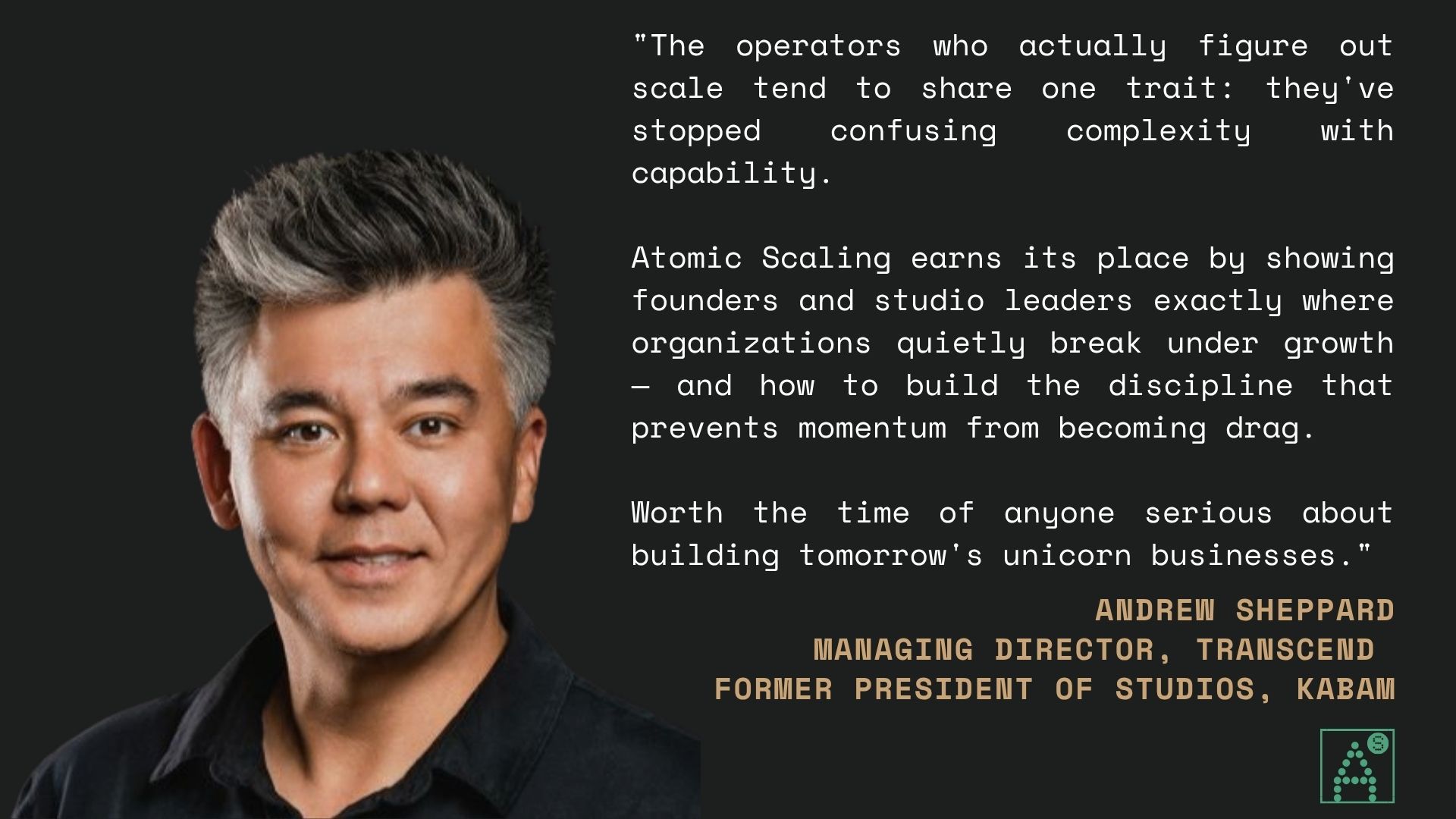
This week I read one of the best pieces on organizational design in the AI age. My friend Andrew Sheppard (investor at Transcend, former President of Studios at Kabam) asks a deceptively simple question: What is the smallest productive unit that can turn intent into shipped output?
As AI compresses the work required to build products and companies, this becomes one of the most important strategic decisions founders, boards, and investors will make. Here's my Atomic Scaling take.
THREE IDEAS
I. The smallest productive unit beats the biggest org chart.
The best companies optimize productive units, not reporting structures. Supercell named the small-team era. Meta is rebuilding around AI-native pods. Kojima caps projects at 150. Sandfall shipped a 2025 hit game ($200–300M revenue) with a 30-person creative atom plus a contractor wrap.
All chasing the same answer: the smallest group that can ship without handoffs, approvals, or translation layers. The future belongs to organizations designed around production, not hierarchy.
II. The Math of Scale: communication paths grow at n(n-1)/2.
Two people, 1 conversation. Ten people, 45 paths. Fifty people, 1,225. Five hundred, 124,750. The problem with growth isn't effort — it's coordination, and coordination scales faster than output.
Not a management problem, a physics problem. As my mum would say: "When two people cook dinner, they just cook. When twenty cook dinner, they spend half the time deciding who cuts the onions."
III. AI is shrinking the atomic unit.
What took 10 people may take 3. What took 3 may take 1. A team becomes a pod; a pod becomes an operator.
So stop asking "How do we scale the team?" and start asking "What's the smallest unit that can deliver the same outcome?" The winners won't simply use AI — they'll redesign their organizations around it.
TWO QUOTES:
I.
“Actual productivity equals potential productivity minus process losses.”
— Ivan Steiner, Author of "Group Process and Productivity"
II.
“The operators who actually figure out scale tend to share one trait: they’ve stopped confusing complexity with capability.
Atomic Scaling earns its place by showing founders and studio leaders exactly where organizations quietly break under growth - and how to build the discipline that prevents momentum from becoming drag.”
— Andrew Sheppard, Managing Director, Transcend | Former President of Studios, Kabam
ONE ACTION FOR YOU:
Map your org into four levels: Atom → Pod → Cell → Company. Then ask:
1. What's the smallest unit that can ship independently?
2. Which layer exists only to coordinate other layers?
3. Which decision can move one level lower tomorrow?
Find the atom. Delete the wrapper. Move the decision down. That's where the next 10x is hiding.
Ludovic Bodin
3x Entrepreneur, 2x Unicorn Investor, 1x IPO
Founder of BOBIC Generational Wealth
Author of Atomic Scaling
P.S. Growth comes from increasing output per unit, not units per output. Adding people adds capacity — but adds coordination faster. Less time coordinating, more time creating.
Read Andrew’s original article, The Smallest Productive Unit. Special thanks to Andrew for inspiring this edition.
Author


