
🚀 3.2.1. Time to Pivot
Supercell was a platform to build multiplayer shooter games on Facebook. Discord was a mobile game company that raised a Series A — weeks before pivoting to a messaging app. Instagram was a check-in app called Burbn.
Every iconic company you admire pivoted its way there — usually from something you'd barely recognize today.
PMF isn't a destination. It's a direction you keep correcting toward.
3 IDEAS FROM ME
I. The gap between what you wish customers needed and what they actually do.
Every pre-PMF founder lives in two realities. The one in the deck: real problem, latent demand, ready market. And the one in the product: activation drop-off on day three, the LOI that never converted, the customer who said they loved it and then went quiet. PMF lives in the gap between those two realities — not in your conviction, in their behavior.
Do they use it without being reminded? Do they complain when it's down? Do they refer someone before you ask? If the answer is no, the gap is the signal. The only honest job at the pre-PMF stage is to close it — not raise, not hire, not scale. Everything else is premature optimization on a thesis the market hasn't confirmed.
II. Breaking the myth: it was never idea → execution → success.
The loop is idea → execution → learning → idea. The flywheel is what you learn. The story founders tell: brilliant idea, sharp execution, PMF found. Clean. Fundable. It has never worked that way, for anyone. Write your bets as a short list of 5 bullets — your specific bets on CPDTM: customer, problem, distribution, technology, monetization. Then ask at every review: is my confidence in each bullet going up or down?
A pivot is simply what happens when you've significantly rewritten that thesis. It's Plan B — a change of strategy, not a collapse of the company. Plan Z is discard everything and survive. Most founders treat a necessary Plan B like it's Plan Z, so they delay until it actually becomes one. The founders who find PMF fastest run more honest experiments and keep their ego out of the update.
III. When to Push Through and When to Pivot
You built on a dream. Then reality hit. Most founders wait for the data to force their hand. Don't. Anything that rationally reduces your belief in your thesis is a signal — investors going quiet, the market shifting, your passion draining, a bigger opportunity becoming visible.
The numbers aren't facts of nature. They're tools for clarity. The real question isn't what do the metrics say — it's do I still believe my five CPDTM bullets?
Don't delay until Plan B becomes Plan Z. When you know, go. Burn the boats.
2 QUOTES FROM OTHERS:
I.
“Pivots are the rule, not the exception. You have to expect the pivot, and generally more than one.”
— Reid Hoffman, Co-Founder of Linkedin & Author of Blitzscaling
II.
"Generally speaking, entrepreneurs are pretty stubborn. We stuck with what we were doing for two years, which at times might have been a year too long."
— Immad Akhund, Founder & CEO, Mercury
1 ACTION FOR YOU:
This week, write your investment thesis in five bullets. Then rate your confidence in each — honestly — on a 1–10 scale.
Not the vision. Not the mission. The thesis: the specific, falsifiable bets your company is making about customer, problem, distribution, technology, and monetization.
The founders who pivot well aren’t braver than the ones who don’t. They just took five minutes to make their beliefs explicit enough to update.
Spread the love. Forward this to a founder who’s been stuck for six months and doesn’t know it yet.
Ludovic Bodin
3x Entrepreneur, 2x Unicorn Investor, 1x IPO
Founder of BOBIC Generational Wealth
Author of Atomic Scaling
P.S: My CPDTM for my wealth management company, BOBIC, the AI-Powered Redistribution Yield Platform - with confidence ratings:
Customer (7): Wealthy people who made their money and want it to do more — earn more, and make the world a little fairer in the process.
Problem (9): AI and robots are making a small group of people very rich, very fast. Everyone else is getting left behind. The question is: how do we build a system where more people benefit from this new wealth — not just the few at the top?
Distribution (8): Find one famous, wealthy entrepreneur who believes in this. Their name opens every door. Others like them follow. The pitch is simple: you earn while you sleep, and something good happens in the world at the same time.
Technology (10): Robots and AI are going to do most of the work. We build the platform that lets people put their money into these machines — starting with trading algorithms, growing into physical robots — and let the machines generate returns for them.
Monetisation (8): Two sides to the marketplace. Bot builders get access to capital. Capital owners get access to returns and a way to give back. We take a small cut of what's earned and what's redistributed. Volume is the business.
P.P.S. The constraint has flipped: the bottleneck used to be execution speed. Now it's belief update speed. Pivoting your beliefs is harder than pivoting your code or your AI stack.
Want to see what the os.atomicscaling.com agent thinks about your pivot decision? Try it yourself — run your own CPDTM through the framework and see what it recommends: pivot, push through, or quit.
Join the movement. The future belongs to founders who update faster.
WHAT THEY ARE SAYING:
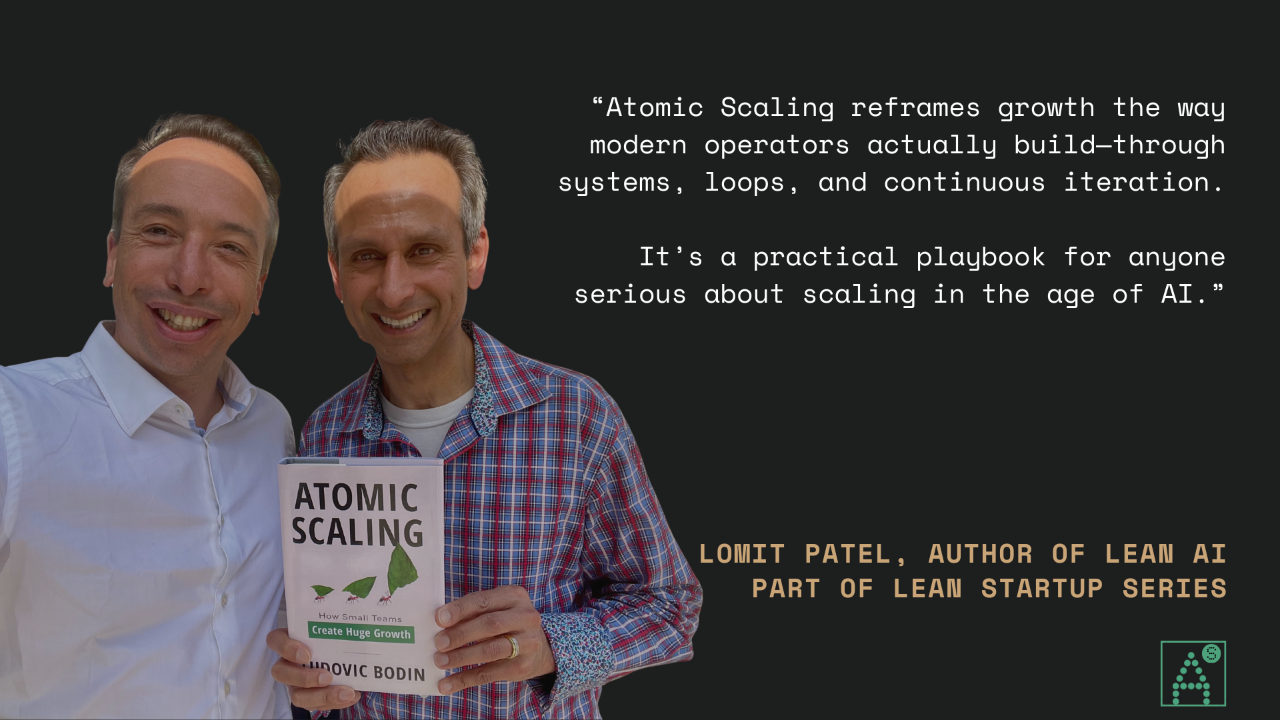
“Atomic Scaling reframes growth the way modern operators actually build—through systems, loops, and continuous iteration. It’s a practical playbook for anyone serious about scaling in the age of AI.”
— Lomit Patel, Author of Lean AI (part of Lean Startup series)