
🚀 3.2.1. How to build an AI-Native Company ::: Atomic Scaling
May 15, 2026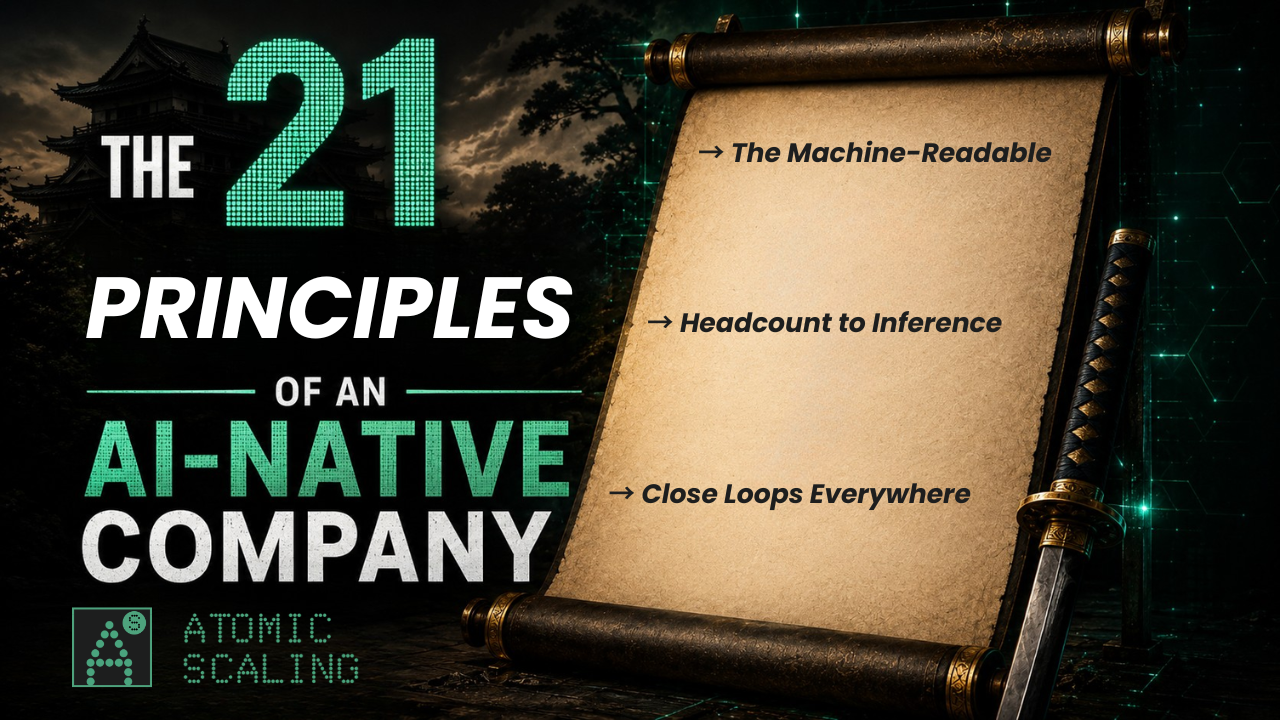
I am openly sharing the 21 operating principles for building enduring AI-first companies — and enabling more of us to participate in this new world of abundance. See how many of these your company already embodies.
3 IDEAS FROM ME
I. Make the Company Legible → The Machine-Readable Company
Principle 1: The organization becomes observable to intelligence. The company becomes machine-readable. Every workflow, decision, and interaction is accessible to AI.
Principle 2 — Every Action Produces an Artifact. Work must leave traces: transcripts, summaries, logs, metrics, embeddings, decisions.
Principle 3 — Optimize for AI Readability. Organizations should be designed for agent comprehension, not just human communication. Turn every key action into data the system can learn from.
Principle 4 — Tacit Knowledge Is a Liability. Undocumented knowledge cannot compound through AI systems. Reduce DMs/emails, embed agents in communication.
Principle 5 — Observability Creates Intelligence. AI can only improve systems it can fully observe and inspect. Track everything with dashboards across functions.
Principle 6 — The Company Runs Through a Unified AI Layer. Meetings, Slack, tickets, CRM, code, and workflows route through shared intelligence infrastructure.
Principle 7 — AI Is an Operating System, Not a Tool. AI should not be a tool your company merely uses; it should be the operating system your company runs on.
II. The Leveraged Organization → Scale Shifts from Headcount to Inference
Principle 8 — Token-Max > Headcount-Max. Scale through inference and orchestration before adding people.
Principle 9 — Inference Becomes the New Labor Force. Compute, context, and workflows become primary production assets.
Principle 10 — Each Human Gets Their Own Agent. Employees evolve into human–agent hybrids with personalized cognitive leverage.
Principle 11 — Managers Become Orchestrators. Coordination shifts from supervising humans to supervising systems and agents.
Principle 12 — Small Teams Gain Asymmetric Power. Tiny high-agency teams can now achieve output previously requiring entire departments. Your company’s velocity is only as fast as its information flow. Every layer of human routing you remove is a direct speed gain
Principle 13 — Remove Middlemen Layers. AI compresses communication and execution chains between idea and outcome. If your company is queryable, artifact-rich, and legible to AI, you should have almost no human middleware.
Principle 14 — Human Leverage Is the Core Primitive. Winning companies maximize the output of exceptional individuals through agents and systems.
III. The Autonomous Company → Close Loops Everywhere
Principle 15 — Closed Loops Create Autonomy. Execute → measure → compare → improve → retry. In the old world, companies operated as open loops. Decisions were made without systematically measuring outcomes. Adaptive systems survive; static systems decay.
Principle 16 — Feedback Loops Matter More Than Prompts. Long-term intelligence emerges from continuous outcome feedback.
Principle 17 — Self-Healing Systems Win. The best AI systems detect, repair, and optimize themselves continuously.
Principle 18 — Software Evolves Into Software Factories. Humans define what to build and judge the output; implementation increasingly becomes the agent’s responsibility.
Principle 19 — Tests Become More Important Than Code. Defining success conditions becomes more important than manually writing implementation. Humans define specifications and tests; agents generate and iterate until those tests pass.
Principle 20 — Execution Becomes Iterative Simulation. AI runs scenarios repeatedly until outputs satisfy target conditions. Use pre-mortems extensively.
Principle 21 — The Future Company Is a Cognitive System. The organization behaves less like a hierarchy and more like an adaptive intelligence network.
2 QUOTES FROM OTHERS:
I.
"The iteration of hypothesis, changes, and measurement will make you better at a faster rate than anything else we have seen." - Gabe Newell, Co-Founder & CEO of Valve
II.
"I realized tech is this thing that can bring people out of whatever situation they're in and often into prosperity. And that's what I want for everyone." — Gary Tan, President at Y Combinator and Creator of GStack & GBrain
1 ACTION FOR YOU:
Founders should treat this less as content and more as institutional pattern recognition. The advantage now belongs to builders who can absorb these lessons quickly, execute with precision, and compound efficiency faster than competitors still approaching AI with outdated operational thinking.
To Your Success,
Ludovic Bodin
3x Entrepreneur, 2x Unicorn Investor, 1x IPO
Founder of BOBIC Generational Wealth
Author of Atomic Scaling
P.S. Agent cards may be the new LinkedIn.
Like Gary Tan's GStack at YC, I'm sharing mine openly — with collaborators, co-founders, and anyone curious.
New this week: a Paranoid Optimist card, inspired by Risto Siilasmaa.
Comes with a pre-mortem skill.
14 skills now live → https://os.atomicscaling.com/
WHAT THEY ARE SAYING:
"Atomic Scaling equips leaders with a framework to sharpen foresight and navigate scaling challenges effectively."
- Risto Siilasmaa, Founder of F-Secure and Former Chairman of Nokia
Author


