
🚀 3.2.1. Two World Models
You are running two companies. Only one is visible to you.
3 IDEAS FROM ME
I. Production World vs. Sales World.
Every business operates two parallel world models, and they rarely talk to each other. The Production World Model is your Reality Engine - what your system actually does (output, reliability, unit economics, ops). The Sales World Model is your Perception Engine - what customer believes your system does (perceived value, trust, narrative).
These two worlds are almost never the same. The mismatch is your strategy problem, not your marketing one. The map is not the territory.
II. The gap doesn’t show up as feedback.
It shows up as deals you “should have” won, churn you didn’t see coming, pricing power you never unlock.
Your product wins in your Reality Engine. You lose in their Perception Engine. You ship something great. A competitor with an inferior product wins the deal, because they owned the narrative. The market doesn’t live in your Production World. It never did.
III. The Missing Layer: Simulation
A world model is a simulator. It predicts how your customer reacts before you act. Without it, GTM is trial, error, burn. Most companies build agents-that-do. Very few build agents-that-predict.
Shifting from task automation to strategic simulation is the move. Build an agent that models your customer’s world, not just one that sends emails into it.
2 QUOTES FROM OTHERS:
I.
“For this to work, a company needs two things: a kind of 'world model' of its own operations, and a customer signal rich enough to make that model useful.”
— Roelof Botha, former Managing Partner at Sequoia Capital (Unity, Qualtrics, etc)
II.
“Money is the most honest signal in the world. People lie on surveys. They ignore ads. They abandon carts. But when they spend, save, send, borrow, or repay — that's the truth. Every transaction is a fact about someone's life."
— Jack Dorsey, Co-founder of Twitter & Block
1 ACTION FOR YOU:
Before you develop and ship anything: simulate it.
Pricing. Messaging. Features. Run it against 500 synthetic customers first. If your model fails, reality will be worse. Open-source tools like MiroFish (52.7k stars on GitHub) are early examples. The principle matters more than the stack.
And remember: Tiny Teams, Huge Growth!
Ludovic Bodin
3x Entrepreneur, 2x Unicorn Investor, 1x IPO
Founder of BOBIC Generational Wealth
Author of Atomic Scaling
P.S. The best founders don’t just build two world models. They have the courage to shut everything down when the models don’t agree. Two world models. One human (OPC) or a team (HAAO) at the switch. That’s the whole game: os.atomicscaling.com
WHAT THEY ARE SAYING:
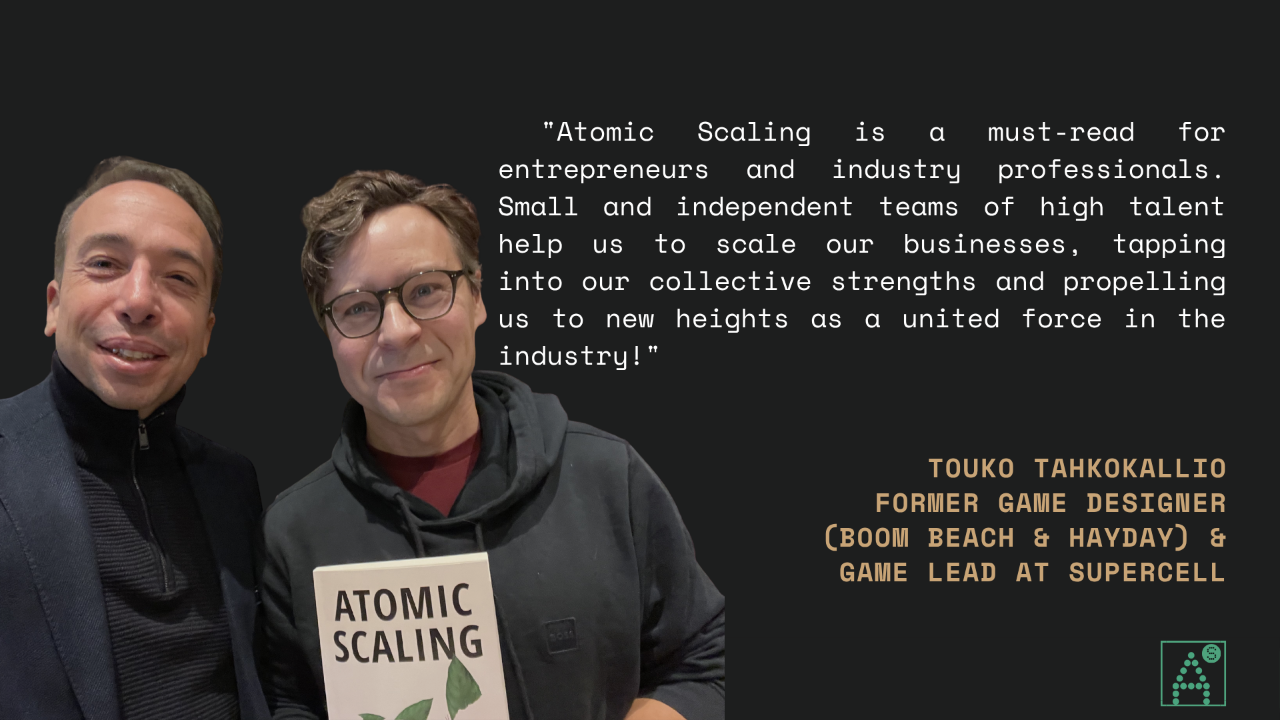
“Atomic Scaling is a must-read for entrepreneurs and industry professionals. Small and independent teams of high talent help us to scale our businesses, tapping into our collective strengths and propelling us to new heights as a united force in the industry!”
- Touko Tahkokallio, Former Game Designer (Boom Beach & HayDay) & Game Lead at Supercell