
🚀 3.2.1. PLG (Prompt, Loop, Graph)
Boris Cherny built Claude Code. This summer he said he doesn't prompt Claude anymore. He writes loops.
Most people heard a buzzword. I heard a job description changing.
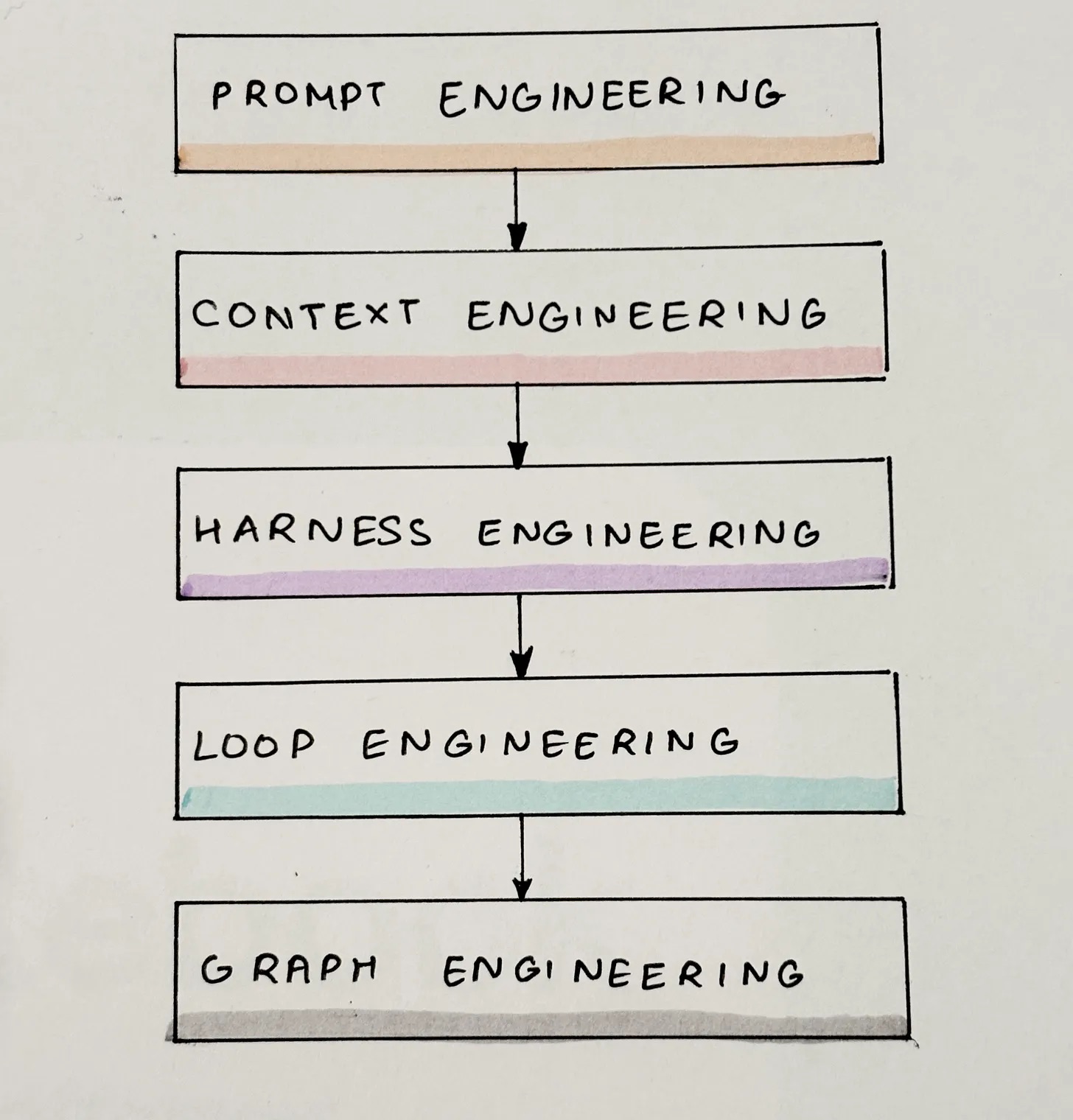
Five terms are now stacked: prompt, context, harness, loop, graph engineering. None replaces the last. Each wraps the one before. The only question that separates them: what does one unit of work look like?
THREE IDEAS:
I. A prompt is a message. A loop is a job. A graph is a company.
Prompt: one message, one answer. Nothing happens unless you type.
Context: same unit, but you choose what surrounds it. The window is finite. Most of the work is cutting.
Harness: tools, files, permissions, a verifier. Agent = model + harness.
Loop: the system prompts itself. Starts on a schedule or event, runs many turns, stops when a condition is met. Not "when it feels done." When the tests pass.
Graph: multiple loops with roles and typed handoffs. Ownership decided up front.
Read it as an org chart. Prompt is an intern. Loop is an employee with a KPI. Graph is a department. You already know how to build a department.
II. The leverage is in the loop, not the graph.
Founders love graphs. Boxes and arrows that look like a real company. Same instinct that hires a VP of everything before revenue.
Cherny's setup at Anthropic is routines: a watcher that drafts a fix for any bug unanswered five hours; one that babysits CI and rebases; loops in parallel worktrees. Half his engineering now happens from his phone. None of it is a graph.
Every serious practitioner says the same: if one loop with good tools and a solid stop does the job, use it. Graphs only when roles truly diverge or you need auditable handoffs. A graph makes you decide structure before you understand the process.
Get one process to run without you. Then clone it. Don't draw the org chart first.
III. Your job moves up one layer.
The loop doesn't remove you. It moves you. Three things: write the memory (every mistake made twice becomes a durable instruction), build the verifier (a loop can't tell when it's finished: it reports "done" while tests still fail), and set the stop (a measurable condition, an iteration cap, a cost ceiling).
Memory, verification, stop. Think of what a HAAO (Human-Assisted Autonomous Organization) looks like from the inside: loops run operations, humans write the loops and own the stops.
TWO QUOTES
"I don't prompt Claude anymore. I write loops and the loops do the work. My job is to write loops." - Boris Cherny, head of Claude Code, Anthropic
"You're no longer the one typing the prompt, you're the one designing the system that types it." Sarthak Rastogi. Read more
ONE ACTION
Pick the most boring workflow you repeat every week. Write it as a loop in three lines:
Trigger — what starts it.
Verifier — how a second pass checks the output.
Stop — the measurable end condition, plus a hard cap on runs.
If you can't write line 3, you don't have a loop. You have a prompt you'll type again next Monday.
Ship it this week. No graph until it has run ten times without you.
Play to Win!
Ludovic
3× Entrepreneur, 2× Unicorn Investor, 1× IPO — Founder of BOBIC Generational Wealth, Author of Atomic Scaling